Sunday, 25 September 2022

Darlington Junior Chess Competition


Darlington Junior Chess Competition


Saturday 8th October 10:00 - 15:30


Elm Ridge Methodist Church hall (DL3 8DJ)


4 age graded sections for all school children


Trophy for first, second and third in each section!!


All participants will play 5 games, this is not a knockout tournament.


There will be a tuck shop available on-site, but recommend to bring a packed lunch.


Entry fee is £7 in all sections.

To enter contact darlingtonchessclub@gmail.com stating
- Name
- Age
- Parent / Carer contact details


Saturday, 19 March 2022

Durham County Junior CHESS Championships

Sunday 3rd April 2022, 1.00 pm – 5.00 pm 

Open to all juniors attending school or living in the former Durham County 
Which apart from Co. Durham includes 
    Darlington, 
    Hartlepool, 
    Stockton, 
    Gateshead, 
    Sunderland and 
    South Tyneside. 
All juniors are welcome – no previous tournament experience is required.

Registration from 12.45 pm and Round 1 will start at 1.00 pm. 
There will be 5 or 6 rounds.  (It is not a knock-out event.) The event, including prize-giving, should finish by 5.00 pm.

Light refreshments including snacks, tea & coffee will be available.

Five age group trophies: 
    under-9, 
    under-11, 
    under-13, 
    under-15 and 
    under-18. 
Ages on 31st August 2021, as for normal current school year. E.g. Under-9 includes current Year 4.

The winner of each section will receive a medal and trophy. 
There will also be a medal and trophy for the best performance by a girl aged under 15. Other medals may be awarded based on number of entries. (All trophies to be returned next year.)

Entry fee £6 per player. Pay on the day, but you must register in advance.
Closing Date – Wednesday 30th March.

Email: junior.tournaments@durhamcitychess.co.uk
Please give 
    name, 
    date of birth, 
    telephone  
    age group you wish to enter, 
    name of school and/or chess club.

For full details about this tournament and reports on previous events, visit the website
http://www.durhamcitychess.co.uk/tournaments.php

Tuesday, 15 March 2022

Return of the Junior Section

 The Junior section will return Monday 25th April.

If you want more info email us darlingtonchessclub@gmail.com

Otherwise come down and play some chess.  club starts 18:00....

Saturday, 15 February 2020

Still Open & World Championship

We are still open!  Juniors Six pm to 7 pm and Adults after 7 Monday nights.

This year is an exciting year in the chess world.  The candidates tournament to decide who will challenge Magnus Carlsen for the World championship crown begins March the 15th.  The match for the title will be played later this year, details are still to be finalised.

I'm a big fan of Magnus Carlsen and his right to be known as a deserving world champion would be hard to argue against.  His last 2 title defences though have been a little underwhelming with his match against Fabiano Caruana ending with every game drawn.  Magnus retained his crown in the rapid tie-break.  Perhaps to be regarded as one of the game's titans he will need a more convincing defence in the next match.  Watching Magnus over the last year nobody has beaten him in classical chess.  He seems to either destroys his opponent with elegant ease or mysteriously play sub-par, get into difficulties, but find robust defence to find a draw.


Whoever emerges from the bear-pit of the candidates knows they have an even tougher task to wrest the crown from the champ. 

Wednesday, 27 September 2017

Kill the monster

Imagine you are a weaker player facing a much higher rated oppenent.  First round of a knockout tournament.  You have White, there is a chance right?

Play through the game to see if the all seeing calculation monster was defeated

Click here for the game

Monday, 1 May 2017

How to read a chess book

I was browsing the internet at work the other day and came across an article called "How to read a chess book".  The author advised taking notes after each chapter, playing through every annotation and ensuring you understand each point that is been made.  I don't disagree with this approach and it may even be the best way to absorb knowledge.

Its just a little on the dull side for my taste. 

I work, have a family and a healthy running obsession, so time to 'study' is limited.  I do, however really enjoy playing through really well anotated games.  Not too many variations, just enough explanation so that I can understand the game.  I have just finished reading "The most exciting games of 2016" by Balogh, Maze & Naiditsch, published by Chess evolution.

In that book my favourite game was between Topalov and Carlsen.  Carlsen plays a beautiful strategic master piece and wins a nice game.  Balogh does a good job explaining the key ideas.


Below you can play through the game with my notes, I can't claim I understood all the points on my own and I have quoted the GM where he did most of the work, but I didn't want to just copy out what he had written, so I have tried to incorporate my own understanding.

Click the link below, for the chessbase viewer, or play through the Gameknott app.

Enjoy


Play through the game


Friday, 14 April 2017

A Recent Game

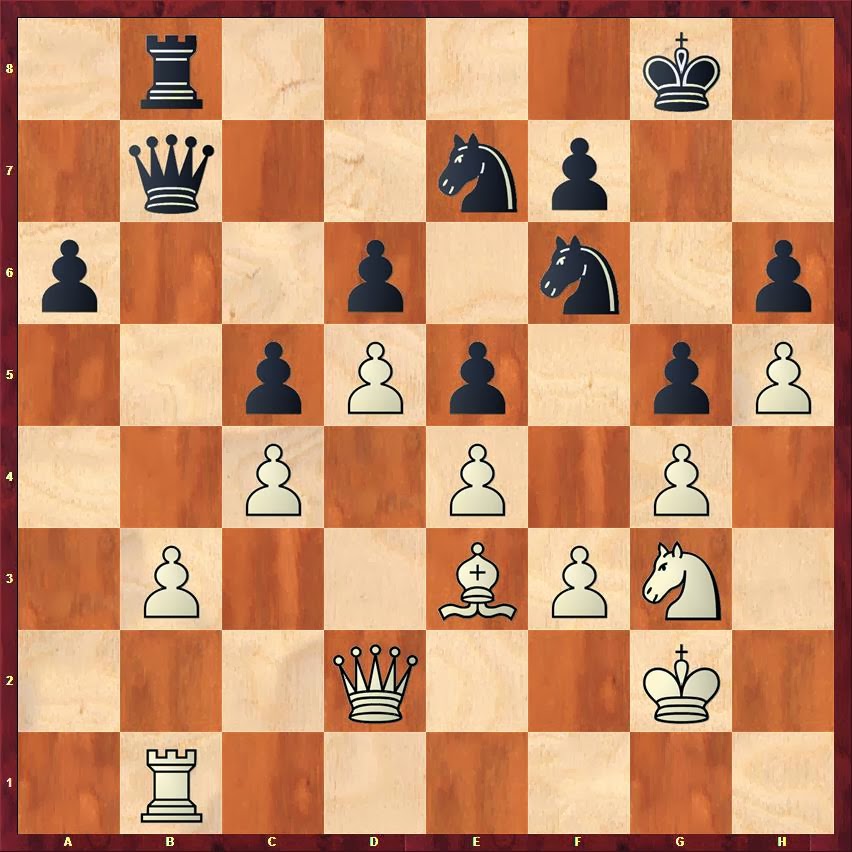
Here is a recent game that I played at Wakefield.  I lost a piece very early, which my opponent kindly returned a few moves later.  There then followed some 'normal' chess before my opponent found a nice idea swapping knight, bishop and rook for 3 pawns and my queen.  Leaving an interesting unbalanced postilion.


Saturday, 9 January 2016

Magic Pawn


One of my favorite games from David Bronstien's Zuric 53 is the Magic pawn game between Kotov and Petrosian.

Black exchanges pieces on d4 leaving a pawn on the square which is doubled and isolated.  Easy to capture, or so it seems, but the magic pawn has a charmed life!

Please click the link below to play through the game with a chessbase view, or use the chess viewer below.
http://www.viewchess.com/cbreader/2016/1/9/Game216018906.html


ChessBase Game

Sunday, 27 December 2015

Home work Xmas 2015

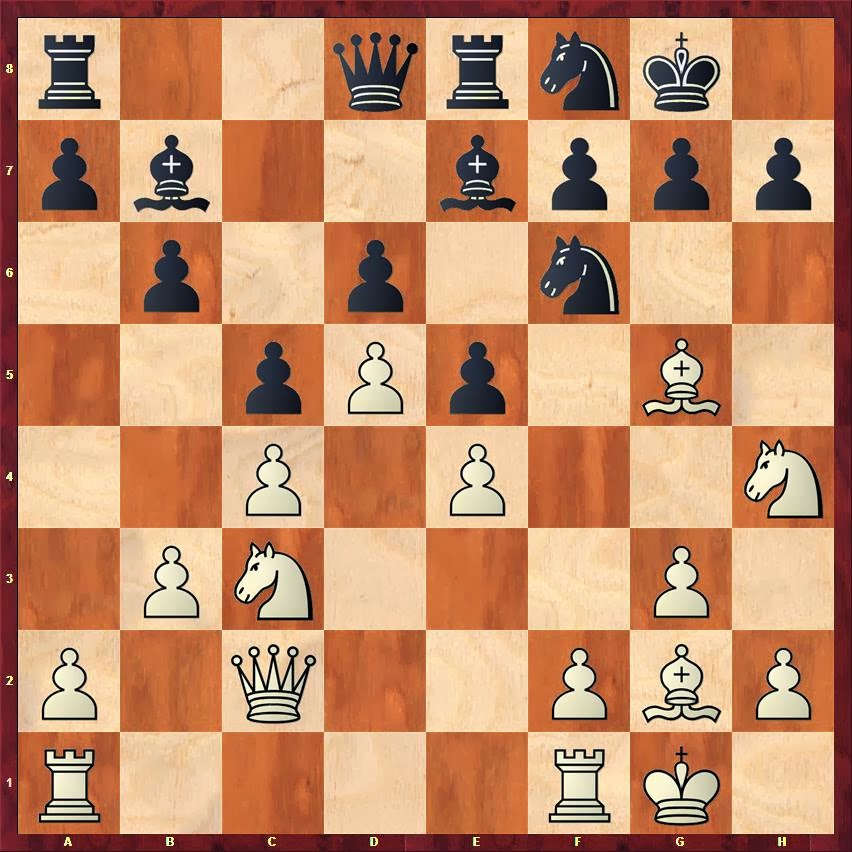
Have a look at the below position.  Its White to play what would you do?


The game is from the first world championship match between Anand and Carlsen in 2013.  Carlsen is White and needed a draw to claim the crown.  He needed to avoid losing and just needed to be careful not to give Black anything to pounce on.  Still he needed only 19 seconds to play his next move.

....

15.Rac1. Magnus understood that Black has pressure on the c-file and Black wants to play ...b5 to erode the White centre and exploit his pressure on the c-file.


The game continued to a draw and Carlsen was crowned 15th World chess champion.

What would you have played?  Perhaps you have heard that rooks belong on open files and wanted to play Rd1.  General principles are there as advice when there are no other concrete factors on the board.
Lets have a look at the mistake 15.Rad1? b5


Black will play ...bxc4 when the pawn on c4 is terminal.  White's best move would probably be 16.Rc1.

Moving the other rook 15.Rfd1?! b5, 16.Rac1


still allows bxc4, but then White has some tactics with the powerfully placed rooks to defend the weak pawn on c4.

After ...bxc4, 17.bxc4 the c-pawn can't be captured, as White has the cute 17...Qxc4, 18.Nd5


Black can first play 17...h6, 18.Bf4 Rfd8 (Black still can't take the pawn due to the Nd5 trick.) 19.Qf3


White has managed to hold the c-pawn, but it's clear to see that it is forever weak.  It would be a clear target for Black to build an attack around.
Strong players will try not to take on such static weakness, as even if they can be defended it means defending passively hoping the other side runs out of resource.  Of course Magnus Carlsen is a class act and completely understood the position.

Remember general principles only after concrete analysis of the position.

Saturday, 22 February 2014

Homework 4

Position 4.1
1.e4 e5, 2.Nf3 Nf6,
Now what do you play?  Try and think about Black's options and how you would answer them.
 Position 4.2
Its Black to play and he can win a good pawn here.  Can you find the moves?


Scroll Down for hints.

week 3 answers:
Position 3.1

1.d4 Nf6, 2.c4 e6, 3.Nc3 Bb4 is the Nimzo-Indian Defence, this is a good opening for both sides and is rich in ideas and variations.

I asked what would you play as White.  Here are some moves

4.e3 - The Rubinstein

4.Qc2 - The classic and my choice, see below

4.Nf3 - Kasparov

4.Bg5 - Leningrad

4.a3/f3 - Samisch

4. g3 - Fianchetto

4. Qb3 - 

4. Bd2 - This is the standard choice of the beginner, not that its bad there are loads of Grandmaster games in this line, but after 4...0-0, 5.a3 Be7 is ok for Black and leaves White's bishop on d2 poorly placed.  There is still an ocean of chess to play.

4.Qc2 would be my choice as White 4...0-0 (Black also has 4...d5 or 4...c5)
5.a3 Bxc3, 6.Qxc2 d5 - White would argue he has the bishop pair, while Black would point to a lead in development.  Almost all the top players have played this line at one time or another, with Carlsen and Kasparov topping the list of greats!

Position 3.2

Remember Black to play and win.
1...Nxg5! - Black creates a loose piece. 2.Nxg5 dxc4! Black attacks the queen, but the main point is he also reveals an attack on the newly created loose white knight.  This double attack loses a piece and the game.
3.Qxc4 Qxg5
Remember Loose Pieces Drop Off (LPDO)

Hints
4.1
Look at the pawn on e5 can it be captured?

4.2
Is the knight really pinned?  Can it take a pawn?

Thursday, 13 February 2014

Member Games - David Oates

David is new to the Darlington club after having some time off chess while raising his family.  They say once bitten, chess is always in you and so it proved with David.  His return soon proved his class, as he dispatched several top local players.  Here he is in action for the North East's 4NCL first team.

David Oates V 2025 (Note this is an ELO grade, but converts to strong!)  

1. c4 e5 The English.  White doesn't fill the centre with pawns, but looks for a more dynamic plan.  Neil Macdonald says "In the English Opening White has the freedom to embark on wing attacks that would be too risky after 1.e4 or 1.d4. There are many instances of White being able to start an enterprising attack on the kingside - often beginning with g4" in his Starting out: the English.    
2.g3 After 1..e5 the opening looks like a Sicilian defense with the colours switched, a standard plan is bishop to g3 which gets called 'the reversed Dragon'.  
2...Nc6 3. Bg2 g6 With g6 Black changes systems again and now we see Black setting his pieses out like a Kings Indian defence.  This system was championed by the great world champion Mikhail Botvinnik
4. Nc3 Bg7 5. e4 d6 


e4 blocks in the bishop on g2 which is generally bad, but in this position the idea is to dissuade Black of playing the standard King's Indian Defense plan of f5 and a king's side attack.

6. d3 Be6 Black plans to set-up a bishop and queen battery and exchange the Bishop on g2
7. Nge2 White plans a pawn break on d4, but avoids a pin
7...Qd7 8. Nd5!


White uses tactics to disrupt Black's plan (8... Bh3 9. Bxh3 Qxh3 10. Nxc7+) 
Perhaps Black could exchange the bishop for knight, but I would say White is slightly better after (8... Bxd5 9. cxd5 Nce7 10. d4) and its hard to change plans once they have begun.

8...Nce7 9. d4 c6 Black can't stand the well placed knight, but declines to swap knights with (9... Nxd5 10. cxd5 Bh3 11. O-O)  This looks ok to me, but perhaps Black thought his kinside attack was still on.

 10. Ne3 Bh3 11. Bxh3 Qxh3 12. d5 


White would like Black to paly (12...cxd5 13. cxd5 Nf6 (13... f5 14. Qa4+ Kf7 15. exf5 gxf5 16. Qd7) 14. Qa4+) to disrupt Black's king.
But plays 12...Qd7 I can't see anything wrong with the natural Nf6, but perhaps Black still longs for f5 and a king side attack.

 13.g4 I was surprised by this move and demanded an explanation.  David says, "Not sure g4 is actually that good – just leaves opponent with decisions to make – gives them more chance to play bad moves."

13...Bh6 14. Ng3 c5 15. h4 Bf4 16. h5 g5?! Black leaves a hole on f5 and as both of White's knights are ready to hop there this isn't a great idea for Black.


17. Nef5 No surprise! Bxg3 18. Nxg3 h6 19. Be3 Nf6 20. f3 O-O 


21. Qd2 White sets up a threat in Bxg5 hxg5 and Qxg5 winning 2 pawns, so Black plays Nh7 Black is starting to look a little passive.  His knight on h7 stops the trick, his other one has to guard f5, which leaves White free to tuck his king out of the way and start a queen side operation
22. O-O a6?! Its clear Black plans to break with b5, but White gets his break in first. 
23. b4 b6 24. bxc5 bxc5 25. Qa5 Nf6 


Finally Black gets his knight off the awful h7 square, but White still retains a better position as Black's knights are unable to find a role and one of them needs to guard the weak f5 square, as allowing White Nf5 would be fatal.  The fight is now for the a and b files.  White is better here, but not winning.
26. Kg2 Rfb8 27. Rab1 White fights for the open file, but Black has to be careful he doesn't allow his a-pawn to become too weak. 27... Qa7 28. Rb3 White will double rooks if he can  
28... Rxb3 Black can't allow that, but now White will use the b-pawn as a battering ram to further weaken the Black queen side. 29. axb3 Qb7 30. Rb1 Rb8 31. Qd2 Nh7
White uses that old Bxg5 trick again! Now his pieces are ready to support the b4 break.
 32. b4 a5 (32... bxa4 allows 33.c5 and if 33...dxc5 34.Bxc5 is difficult for Black as the defender of f5 is attacked by the bishop and if Nf5 is allowed Black is finished.)
33. b5 a4 Both sides have a passed pawn, but Black's a-pawn is not defended and looks weaker than White's b-pawn. 

34. Qc3! White will swap the queen onto a3 to put pressure on Black's a-pawn , but also lays a fiendish plan. If (34... Ra8 35.Bxc5! dxc5 36.Qxe5 when the knight is awkward as after say a3 37.d6 leaves the knight with limited options and White has a pawn on d6 and access to f5 for his knight) 

34...f6 35. Qa3 Qa7 36. b6 Rxb6 37. Rxb6 Qxb6 38. Qxa4 Kf7 


Black has to be careful not to allow White's queen in with Qe8.  White's queen is much more of a threat than Black's.

39. Qb5 Qxb5 Black is happy to swap queens, but now he is lost!!
40. cxb5 Ke8 41. b6 
It looks as though Black's king can rush to b8 to blockade the troublesome pawn, but there is a problem 
(on 41... Kd7 42. b7 Kc7 43. Bxc5! dxc5 (43... Kxb7
44. Bxd6 Ng8 45. Nf5) 44. d6+) so Black tries to use a knight to blockade instead.
41... Nf8  42. b7 Nd7 43. Bd2 The pawn and the Bishop create a 'wall' on the c-file stopping the king ever crossing onto the b-file.
43...Nb8 The knight is well placed to blockade the pawn, is it enough to draw?
44. Ba5 Kd7 
With the wall blocking the Black king Black has little more than Na6-Nb8.  White exploits this helplessness with

45. Kf2!! White simply plans to use his king to get access to b6.  There is nothing Black can do to stop Kf2-e2-d3-c4-b5-b6

45... Na6


46. Ke2 1-0 - Black sees the king's march and quits.  Nice control and an unusual finish, although David's king march reminded me of Nigel Short's game against Timman where he used his king to march into the enemy camp.  That game is copied below if your interested.

[Event "Tilburg"]

[White "Short, Nigel D"]
[Black "Timman, Jan H"]
[SourceDate "1992.02.01"]

1. e4 Nf6 2. e5 Nd5 3. d4 d6 4. Nf3 g6 5. Bc4 Nb6 6. Bb3 Bg7 7. Qe2 Nc6 8. O-O O-O 9. h3 a5 10. a4 dxe5 11. dxe5 Nd4 12. Nxd4 Qxd4 13. Re1 e6 14. Nd2 Nd5 15. Nf3 Qc5 16. Qe4 Qb4 17. Bc4 Nb6 18. b3 Nxc4 19. bxc4 Re8 20. Rd1 Qc5 21. Qh4 b6 22. Be3 Qc6 23. Bh6 Bh8 24. Rd8 Bb7 25. Rad1 Bg7 26. R8d7 Rf8 27. Bxg7 Kxg7 28.

R1d4 Rae8 29. Qf6+ Kg8 30. h4 h5 31. Kh2 Rc8 32. Kg3 Rce8 33. Kf4 Bc8 34. Kg5

1-0

Wednesday, 5 February 2014

Two positions - homework 3

Position 3.1
1.d4 Nf6 - This knight move leads to a group of defenses to d4 called the Indian defenses.
2.c4 e6, 3.Nc4 Bb4 is this is the Nimzo-Indian.
What would you play as White?  They are loads of options so there is no right or wrong answer.
What would you play as Black against White's next move?

Position 3.2

Black to play and win


Scroll down for hints, but 3.1 has no hint, as they is no right answer...

Last weeks answers

2.1
This is the start of the Ruy Lopez.  Black is attacking the e4 pawn, but this can be ignored with 5.0-0 after 5...Nxe4 6.Re1 will win the pawn back but 6.d4! is stronger as exd4 leaves the e-file open when Re1 is very very dangerous for Black as the knight is in peril.  Most Black players don't take on d4 and White takes the pawn on d5.
Note:5...Ne4 is known as the open variation, but Black has many other lines available to him.


2.2
The clue to this position are the White queen and King on the same diagonal.  Perfect for skewer or Pin.  We need the dark squared bishop for this maneuver, if the Black knight were somewhere else we would have 1...Bxf6!  Also winning the queen.  So we look for checks.  Nc7 doesn't work, 1...Nf6+ does 2.Nxf6 Bxf6 and wins


Hint 3.2
Loose pieces drop off - first get a loose piece on g5

Sunday, 26 January 2014

Two positions - homework 2

Position 2.1

This position comes from the Ruy Lopez.  If you open with 1.e4 no doubt you have seen it before.

What would you play as White, can you list Black's threats and let me know why your move is good.  Also think of another move for White.


Position 2.2


Its Black to play can you find the winning moves?

There are clues below, but first answers from last week.

Answers from week 1

1.1

Black is trying to hold the pawn.  White should undermine Black's pawns with 4.a4
4... c6 (4...a6?, 5.axb5 and Black's a-pawn is pinned, or 4...bxa4? 5.Bxc4 when White is ahead in development and will win the a-pawn)
5.b3 sees another undermining move.  Another way to play is (5.axb5 cxb5, 6.Nc3 when we see a true Gambit take a look at this position, in fact go further and play some games using this if possible.)
5. ...cxb3, 6.axb5 cxb5, 7.Bxb5 Bd7, 8.Qxb3 When material is equal, but White is better placed.
1.2
The stunning 1.Qxh7 is easy to find when you see that the King is in a corridor, like a back rank mate, because the knight controls g8 and g6. 1...Kxh7, 2.Rh5#
Corridor mates are quite common, or rather tactics that win material to prevent them are!!  If we can build up a number of positions we have seen before this gives us ideas at the board, so queen sacrifices are at least considered.

Clues for week 2
2.1 Did you notice e4 under attack?  White can use a pin to ignore the threat.

2.2 The King and queen are lined up on the e1-a5 diagonal, this is a trigger to look for a skewer.  Look at your checks first.

Saturday, 18 January 2014

Two positions - Homework 1

This week the following positions are the players homework.

The following diagram is from the queens gambit accepted.
1.d4 d5, 2.c4 dxc4, 3.e4 b5 Black wants to try and keep his extra pawn can you find the next few moves for White.  See below for clues:-


The next position is a classic.  Its a quick mate can you see the sequence?  Again, see below for clues


Clue Position 1

White should use his own pawns to undermine Black's.  eventually Black will be left with an extra pawn that White will be able to take with Bishop or Queen.

Clue Position 2

Notice that the knight on e7 controls g8 and g6.  With Black's pawn on g6 we have a corridor of death.  All White needs to do is open the h-file and then call check with a rook or queen along the newly opened h-file.

Its going to take a sac!!

Wednesday, 9 October 2013

Men V Boys

Three of our juniors juniors played against 3 of our adults.  They lost 2-1.  Below is the victory


Sunday, 8 September 2013

Agm 2013

The 13/14 season began September the 1st the the AGM.  Last years competition winners were presented with their trophies.
The winners were


Wallace Inman Shield, J Samms, Pic below
 Pike Pease Cup, J Williams, Pic below
  Frank Oliver Trophy, J Samms, Pic below
 E.D.Walker Shield, J Samms, Pic below
Intermediate Cup,  R Howell.
Bob Coulson Board, S Dauber.
                                    Lightning Trophy,  K Wilson

Next the teams for the new season were voted on.  There will be
3 teams in the Durham league.
4 teams in the Cleveland league

1 team on the Darlington league

The 4 teams in the Cleveland division are split over 3 divisions and will give all abilities a chance to play.

There will also be the following internal club competitions.
Walker Shield*
Pike Pease Cup*
F.Oliver Trophy*
Intermediate Trophy
Quickplay*
A summer competition.*
Lightning (To be played Monday 9th September 2013).
On one night, to be decided a 15min knock out rapid play will be held at the club.
Darlington Vs Durham

*Games graded by ECF.

I look forward to seeing you at the club.  If you want to see any games published send a PGN, or the moves to darlingtonchessclub@gmail.com

Saturday, 20 July 2013

The Northern Giga final

The Delancey UK Schools chess challenge is the largest chess competition in the world!  The idea is to allow as many children as possible to compete in their schools, or clubs.  Play is over 7 rounds and if you win 5 or more games you qualify for the local mega final.
The mega final is usual played in a county over 6 rounds banded into age groups.  Children who win at least 4 games qualify for the giga final.  There are two giga finals North and South, similar to the mega final play is over 6 rounds with children in age sections, often there are 3 sections for each age group.  The winners qualify for the tera final where all children compete for the £2000 prize!

Harry Wilson from Darlington managed to qualify for the Northern giga final played in Manchester on 13/07/13.

Harry won 2 games drew 1 and lost 3.  We had hoped for at least 3 points.  Having started well on 1.5/2 he met Adam Bennet who won the section with 6/6.  Harry actually played well in this game, but fell for a trick and then lost.  The margin between victory and defeat in chess can be very small.  Having lost it can be hard to recover.  The game follows:

1. e4 c5 2. Nf3 d6 3. Bc4 {I would prefer to see d4 here.  White develops the bishop which is good, but its exposed on c4.}
3... a6 4. O-O e6 5. Nc3 b5 6. Bd3 {Be2 seems more logical} Nc6 

7. b3! {A good solution to the dark squared bishop's problem.} 
7... Nf6 8. Bb2 Be7 9. Qe2 {White has all his pieces in play and has connected his rooks.  I'm pleased with White's play so far.} Bb7 

10. e5! {I like this move and in the game White gets a winning advantage.}
10... Nd7 {White has to consider the following variation.} (10... dxe5 11. Nxe5 Nxe5 12. Qxe5 {
Both sides have chances, which I would asses as roughly level.})
11. exd6 Bxd6 12. Ne4

{To play good chess you have to keep your pieces safe, play slowly and
consider all your options and try to get all your pieces involved.  White's
rooks don't have a roll and Re1 (either) could have been an option.    Any
generic rules in chess shouldn't be blindly followed you need to think about
the position.  Ne4 is a good move as it attacks Black's bishop, which is
unprotected while placing the knight on e4 where it enjoys a commanding
position.}
12...Be5 {There now follows a long sequence of exchanges.} 
13. Nxe5 Ndxe5 14. Nxc5 Nxd3 15. Nxb7 Qc7 16. Qxd3 Qxb7 

{This is the most important point in the game for White.  He's a pawn up, has a safer king and also the bishop should be better than the knight.  It is clear that White is better much better.    Now he needs a plan: How can he get the rooks into the game, how can he use his extra pawn. There are so many options, perhaps simply Rfe1 to place the rook on an open file, a4 at some point and notice that bishop and
queen can use the tactical focal point on g7 to gain time with ideas like Qg3 or Qc3.}
17. Qf3 O-O 18. Qc3 {I think this idea should be kept in reserve if needed}
18... f6 19. Rfe1 Rac8 {Black sets up a discovery threat.  White needs to consider Ne7 and Ne5.  Black does have a strong threat here, so White needs to either move the queen or defend c2 e.g Rc1.}

20. Rxe6?? Nd8 {White plays a greedy pawn grab which will cost him the excahange and a pawn or two.} 21. Qd4?? {White implodes clearly in shock and dismay at seeing a won game turn
against him in just one move.  Clearly Qe3 is better.} Nxe6 {The game is now
over...} 22. Qg4 Qf7 23. Re1 Rfe8 24. d4 Rxc2 25. Rb1 Rec8 26. h3 Rd2 27. d5
0-1

Saturday, 8 June 2013

Juniors v Adults

Some of the promising juniors are perhaps ready to play against adults.  A 'friendly' was arranged between the bright kids and game adults.  The kids pictured below were Arlan, Harry, Dylan and Joe.

Adults were Boye, Brian, James (Junior coach) and Phil.
Board 4 was Phil - Dylan.
Board 3 Harry - James
Board 2 Brian - Arlan
Board 1 Joe - Boye
The games were 60 minutes all in and all players had to record moves except Dylan who's still in the infants and needs to improve his writing a little first.

The games were played seriously, but in a relaxed atmosphere.

On this occasion the adults triumphed 4-0.  The games have been analysed and advice given to the kids.  We can use the games to help coach the kids and hopefully the children will start thinking about their own play too.
This is the start for these juniors of their playing careers.  The plan is to ease them into the adult team while still playing in junior competitions given them a balanced playing environment.

Below are three of the games, board 4 was unfortunately undecipherable (Phil is also a new player and just started recording the moves).  The comments are aimed for the junior playing the game and should help them to improve.  I would encourage any player young or old to analyse their own games adding some comments is a great way to do this.  Add some variations at key points and try and decide where the game turned (Note this isn't that blunder we all know loses the game, but often the self inflicted pressure that caused the blunder!!)